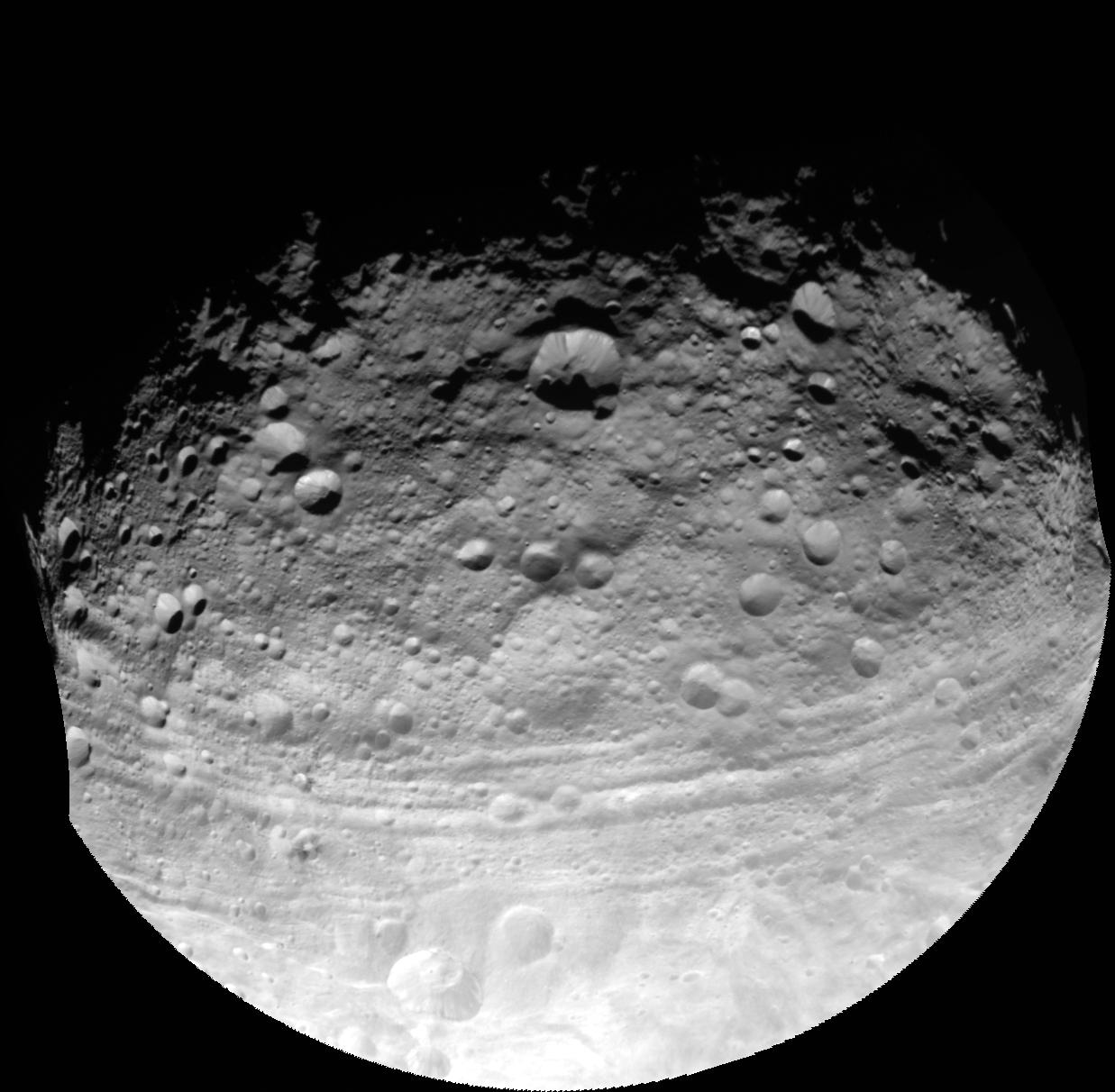
The main asteroid belt lies between Mars and Jupiter and contains rocky, metallic, and icy remnants left over from the formation of the Solar System about 4.6 billion years ago. It is not the shattered remains of one former planet. Instead, it is material that never fully assembled into a large world.
Jupiter played a major role. Its strong gravity disturbed the orbits of growing bodies in this region, making collisions more destructive and preventing one stable planet from forming. The result is a broad population of asteroids, dwarf planet Ceres, and unusual objects such as Vesta and Psyche.
Where the asteroid belt is located
The main belt occupies a broad region between the orbits of Mars and Jupiter. Despite how movies often portray it, the belt is mostly empty space, and spacecraft can pass through it safely with careful navigation.
The objects range from dust-sized fragments to bodies hundreds of kilometers across. NASA notes that the combined mass of all asteroids is still less than the mass of Earth’s Moon.
Why it never became a planet
During the young Solar System, dust and rock collided and merged into larger bodies called planetesimals. In many regions, those planetesimals continued growing into planets.
Between Mars and Jupiter, however, Jupiter’s powerful gravity repeatedly disturbed their orbits. Instead of merging smoothly, many objects collided at higher speeds and fragmented. This prevented the region from becoming one large planet.

Ceres and Vesta are special
Ceres is the largest object in the belt and was reclassified as a dwarf planet in 2006. Dawn arrived there in 2015 after first orbiting Vesta, making Ceres the first dwarf planet ever orbited by a spacecraft.
Vesta is the second most massive body in the belt. Unlike most asteroids, it differentiated into a crust, mantle, and core early in Solar System history, making it more planet-like than a typical small asteroid.
What asteroids are made of
Asteroids are not all the same. Some are rich in rocky silicates, others contain carbon-rich material, and some contain large amounts of metal. These differences reflect where and how the objects formed and how they were altered by impacts and heating.
One of the most intriguing examples is Psyche, a large metal-rich asteroid. NASA’s Psyche mission is traveling there to investigate whether it may represent material related to the core of an early planetesimal.

Why missions study the belt
Asteroid missions allow scientists to compare different kinds of early Solar System material up close. Dawn revealed that Vesta and Ceres are dramatically different worlds even though they occupy the same broad region.
Future and ongoing missions such as Psyche extend that story by exploring bodies with unusual compositions. Together, these missions help scientists understand how rocky planets like Earth acquired their layered interiors and how collisions shaped the early Solar System.
FAQ
Is the asteroid belt dangerous for spacecraft?
Usually not. The belt is extremely spread out, so the average distance between large objects is enormous.
Is Ceres an asteroid or a planet?
Ceres was once classified as an asteroid, but today it is officially classified as a dwarf planet.
Could the asteroid belt ever become a planet?
No realistic process is expected to gather the present belt into one planet. Its objects occupy many separate orbits and the belt contains far too little mass.