

A black hole is a region where gravity is so strong that, once something passes a boundary called the event horizon, it cannot return to the outside universe. Black holes are extreme objects, but they still follow the laws of physics.
What is a black hole?
A black hole is an astronomical object with so much mass packed into such a compact region that its gravity becomes extraordinarily strong. The black hole itself does not shine, but material outside it can glow intensely.
Where does that gravity come from?
Gravity depends on mass and distance. A black hole concentrates a large amount of mass into a very small region. Far away, its pull is no more mysterious than the gravity of another object with the same mass. The most extreme effects appear only very close to the black hole.
What is the event horizon?
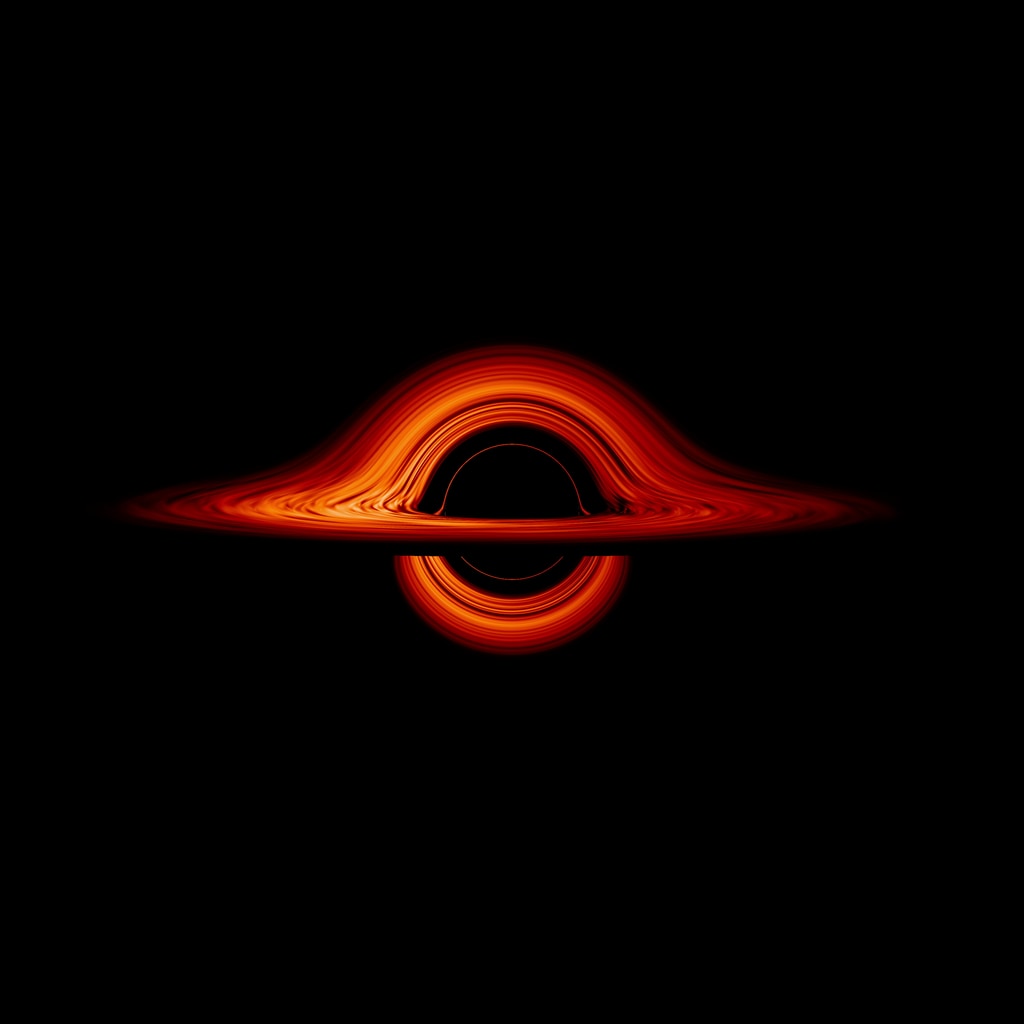
The event horizon is not a solid surface. It is a boundary in spacetime. Once matter or light crosses it, escape to the outside universe is no longer possible. The famous black-hole images show bright surrounding material and the black hole's shadow, not a solid surface.
Do black holes suck in everything?
No. Objects can orbit a black hole just as planets orbit stars, provided their paths are stable and remain outside dangerous inner regions. A black hole does not reach across a galaxy and vacuum up everything around it.
How do black holes form?
Some black holes can form when very massive stars reach the end of their lives and their cores collapse. Astronomers also observe supermassive black holes in the centers of large galaxies. How the earliest supermassive black holes grew so quickly is still an active research question.
How can we detect something that emits no light?
Astronomers detect black holes by their effects. Gas falling toward one can heat up and emit powerful radiation before crossing the event horizon. Stars may orbit an unseen massive object. Merging black holes can produce gravitational waves, and black-hole gravity can also bend light.

Main types of black holes
Two broad classes are extensively observed: stellar-mass black holes and supermassive black holes. Astronomers also investigate intermediate-mass candidates that could help explain how the largest black holes grew.
FAQ
Can light escape a black hole?
Not after it crosses the event horizon.
Would the Sun turn into a black hole?
No. The Sun is not massive enough to end its life as a black hole.
Can planets orbit a black hole?
In principle, yes. Stable orbits can exist outside the dangerous inner region.
Can we photograph a black hole?
We can image the glowing material and shadow around certain supermassive black holes. The Event Horizon Telescope produced the first horizon-scale image in 2019.