

Our Solar System is built around the Sun and includes eight major planets, dwarf planets, moons, asteroids, comets and countless smaller objects. The eight planets, moving outward from the Sun, are Mercury, Venus, Earth, Mars, Jupiter, Saturn, Uranus and Neptune.
The Solar System begins with the Sun
The Sun contains almost all of the Solar System's mass. Its gravity keeps planets, dwarf planets, asteroids, comets and smaller objects in orbit. The planets formed from a disk of gas and dust around the young Sun more than 4.5 billion years ago.
The eight planets in order from the Sun
The order is Mercury, Venus, Earth, Mars, Jupiter, Saturn, Uranus and Neptune. The first four are relatively small, dense and rocky. The four outer planets are much larger and contain far more gases and volatile materials.

The four inner rocky planets
Mercury, Venus, Earth and Mars have solid surfaces and are often called terrestrial planets. Mercury is the smallest and closest to the Sun. Venus has a dense carbon-dioxide atmosphere and extreme surface heat. Earth has liquid oceans and a life-supporting atmosphere, while Mars is a cold desert with evidence that liquid water shaped its ancient surface.
The giant planets
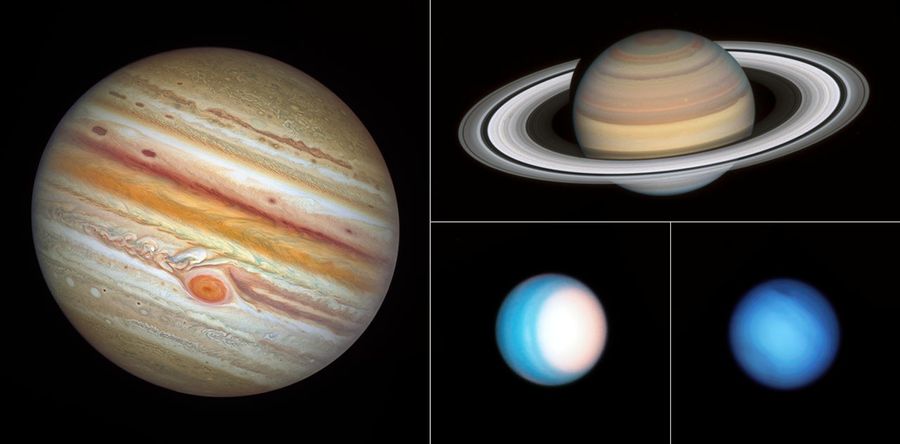
Jupiter and Saturn are gas giants dominated by hydrogen and helium. Uranus and Neptune are called ice giants because their interiors contain larger proportions of water-, methane- and ammonia-rich materials. All four have rings and extensive moon systems.
Why every planet is different
Distance from the Sun matters, but it is only part of the story. Planet size, composition, atmosphere, internal heat, collisions and geological history all helped create very different worlds from the same original protoplanetary disk.
Beyond Neptune
Beyond Neptune lies the Kuiper Belt, home to many icy bodies including Pluto and other dwarf planets. Even farther away, the distant Oort Cloud is thought to be a vast reservoir of icy objects that can become long-period comets.
A system still being explored
Robotic missions continue to study planets, moons, rings and small bodies. Exploring our own Solar System gives astronomers a local laboratory for understanding planetary systems around other stars.
FAQ
What are the eight planets in order?
Mercury, Venus, Earth, Mars, Jupiter, Saturn, Uranus and Neptune.
Why is Pluto not one of the eight planets?
Pluto is classified as a dwarf planet under the modern astronomical definition because it has not cleared its orbital neighborhood.
Which planet is the largest?
Jupiter is the largest planet in the Solar System.