
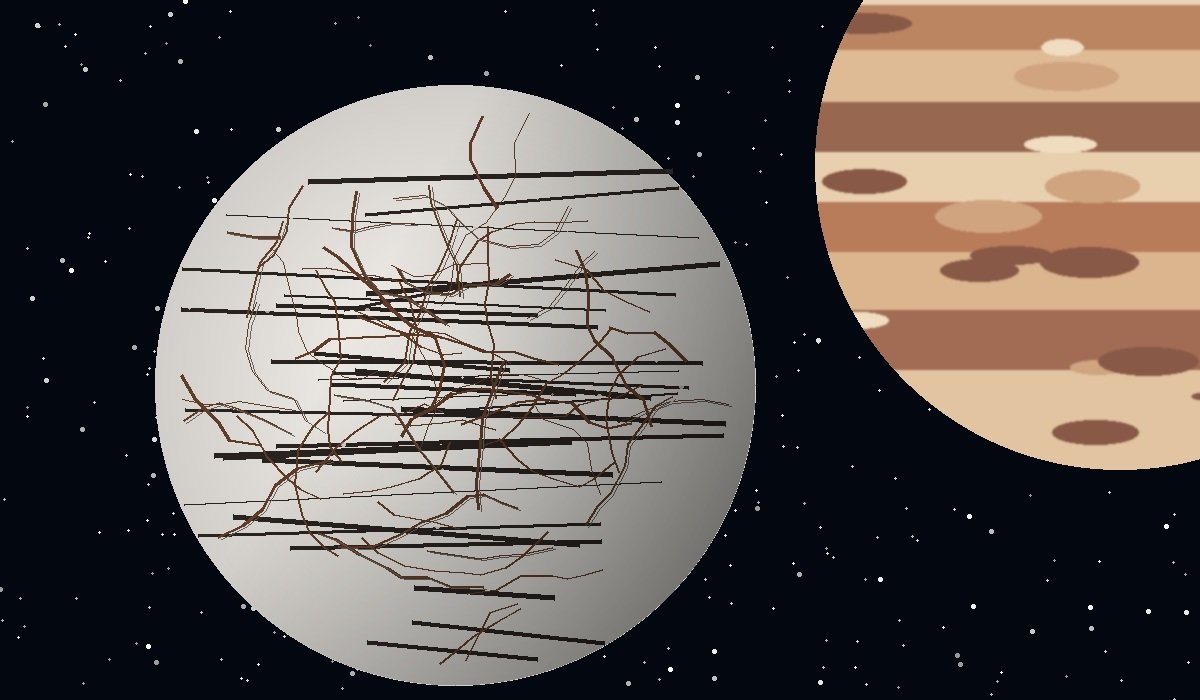
Europa is compelling because strong evidence points to a salty ocean beneath its ice. Europa Clipper is designed to test the moon’s structure and chemistry and assess whether it could provide conditions suitable for life.
A small moon with a big scientific story
Europa is one of Jupiter's four large Galilean moons. It is slightly smaller than Earth's Moon, but its bright, fractured surface has made it one of the most important targets in planetary science.
The reason is not what we see on top. The strongest interest is focused beneath the surface, where multiple lines of evidence indicate a global ocean of salty liquid water may exist under an outer shell of ice.
Why scientists think an ocean is there
Spacecraft images show a surface crossed by long ridges, cracks and disrupted regions known as chaos terrain. Europa also has relatively few large impact craters, suggesting that its surface has been geologically renewed over time.
Measurements from NASA's Galileo spacecraft provided another major clue: Europa interacts with Jupiter's magnetic field in a way consistent with an electrically conducting layer below the surface. A global salty ocean is a strong explanation for that signal.
How can liquid water survive so far from the Sun?
Europa receives little solar warmth compared with Earth, but it experiences another source of energy. Jupiter's gravity, together with gravitational interactions involving neighboring moons, repeatedly flexes Europa as it travels around its orbit.
This tidal flexing can generate heat inside the moon. The exact structure and thickness of the ice shell are still under study, but internal heating helps explain how liquid water could persist beneath an extremely cold exterior.
Does an ocean mean life?
No. Liquid water is an important ingredient for life as we know it, but water alone is not evidence of biology. Scientists also want to know about chemistry, energy sources, the ocean floor and whether useful compounds can move between Europa's surface and interior.
That is why Europa is often described as a potentially habitable environment rather than an inhabited world. The scientific goal is to determine whether the conditions needed for life could exist there.
What Europa Clipper is designed to investigate
NASA's Europa Clipper mission launched in October 2024 and is traveling toward the Jupiter system. Its instruments are designed to study Europa during repeated close flybys rather than land on the surface.
The mission will investigate the ice shell, the possible ocean, surface composition, geology and the space environment around Europa. Radar, cameras, spectrometers, magnetic measurements and other instruments will help scientists build a far more detailed picture of the moon.
Why Europa matters even if no life is found
Europa can teach us how ocean worlds work, how ice and water interact on other bodies, and how habitability might arise far from a star's traditional habitable zone.
Even a result showing difficult conditions for life would be valuable. It would narrow the range of environments scientists should consider when searching for biology elsewhere in the Solar System and beyond.
Simple takeaway
Europa is compelling because strong evidence points to a salty ocean beneath its ice. Europa Clipper is designed to test the moon’s structure and chemistry and assess whether it could provide conditions suitable for life.
Trusted sources & further reading
Hero image: original Neela Asman illustration created for this article.