
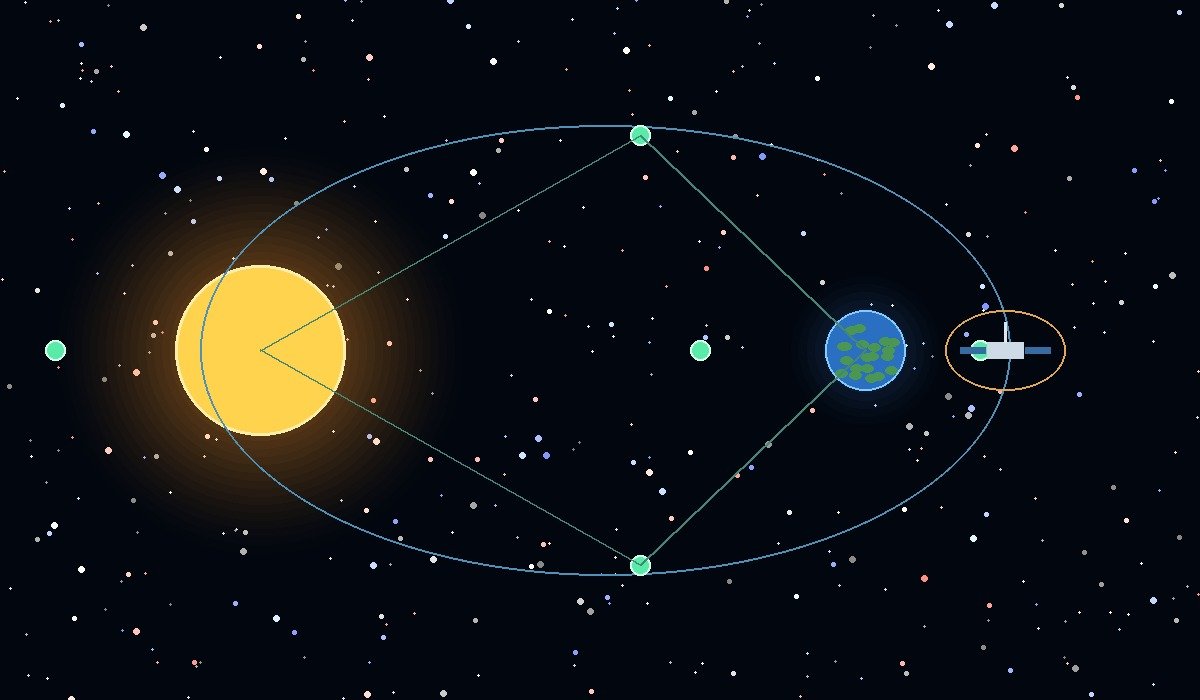
Lagrange points are five special regions defined by the gravity and orbital motion of two large bodies. Spacecraft use orbits around these regions to gain useful viewing geometry and reduce station-keeping demands.
What is a Lagrange point?
In a system with two large orbiting bodies — such as the Sun and Earth — there are five locations where a much smaller object can move in a repeating relationship with them. These locations are called Lagrange points, labeled L1 through L5.
The idea is often described as a balance of gravity and orbital motion. A spacecraft near one of these regions can maintain a useful geometry relative to the two large bodies while making only limited station-keeping corrections.
The five points in simple terms
L1 sits between the two large bodies. In the Sun–Earth system, spacecraft near L1 have a continuous view of the Sun, making the region valuable for monitoring solar activity.
L2 lies beyond Earth on the side opposite the Sun. It is especially useful for space telescopes because the Sun, Earth and Moon remain in roughly the same direction, making thermal shielding and deep-space observing easier. L3 lies on the far side of the Sun, while L4 and L5 sit about 60 degrees ahead of and behind the smaller body's orbit.
Are spacecraft perfectly stationary there?
No. The popular phrase 'parking spot' is helpful but incomplete. Spacecraft generally orbit around a Lagrange point in halo or Lissajous-type paths rather than sitting at one mathematical point.
L1, L2 and L3 are dynamically unstable, so spacecraft need periodic corrections. L4 and L5 can be stable in suitable two-body systems, which is why natural populations such as Trojan asteroids can gather near them.
Why the James Webb Space Telescope uses L2
The James Webb Space Telescope operates near the Sun–Earth L2 region, about 1.5 million kilometers from Earth. That geometry lets Webb keep the Sun, Earth and Moon on the warm side of its large sunshield while the telescope faces cold deep space.
Thermal stability is crucial for an infrared observatory. L2 also provides a convenient observing environment without requiring the telescope to orbit Earth and repeatedly pass in and out of sunlight.
Other missions use Lagrange regions too
Solar-observing spacecraft have operated near Sun–Earth L1, where they can watch the Sun before solar-wind disturbances reach Earth. Other observatories and scientific missions have used or are designed to use L1 or L2 for stable viewing geometry.
The exact orbit around a Lagrange region is chosen for mission goals, communications, thermal control, fuel use and launch trajectory.
A clever use of orbital mechanics
Lagrange points do not cancel gravity. Instead, they are a result of how gravity and orbital motion work together in a rotating system.
They are a powerful example of mission design: by choosing the right place and orbit, engineers can reduce fuel demands and create observing conditions that would be difficult to achieve close to Earth.
Simple takeaway
Lagrange points are five special regions defined by the gravity and orbital motion of two large bodies. Spacecraft use orbits around these regions to gain useful viewing geometry and reduce station-keeping demands.
Trusted sources & further reading
Hero image: original Neela Asman illustration created for this article.