
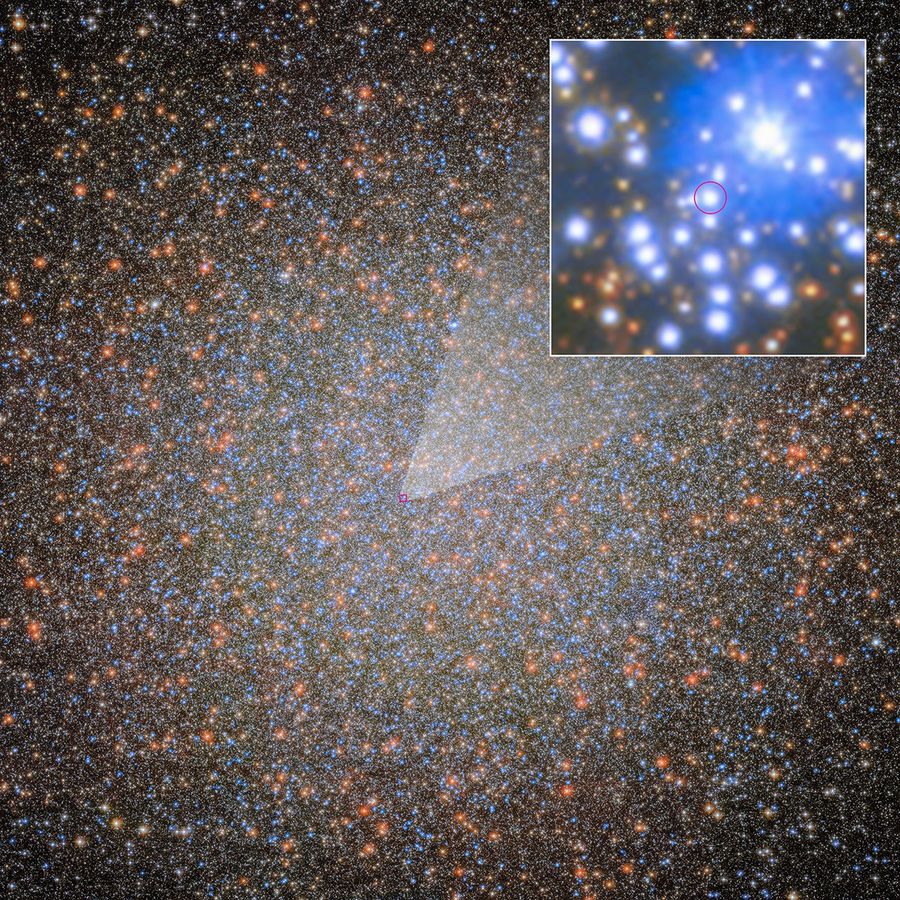
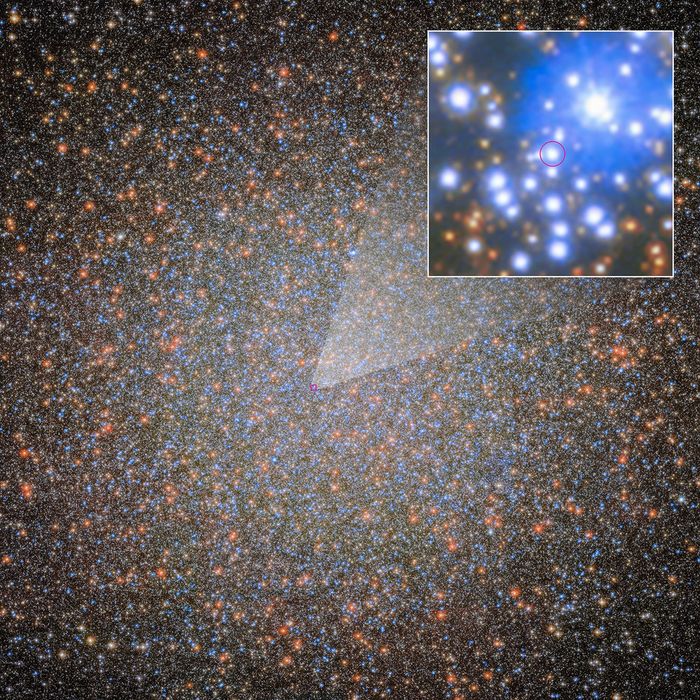
Astronomers using more than two decades of Hubble measurements together with Webb data have identified Omega Centauri’s first confirmed stellar-mass black hole, a dark companion in a long-period binary system.
Why Omega Centauri is unusual
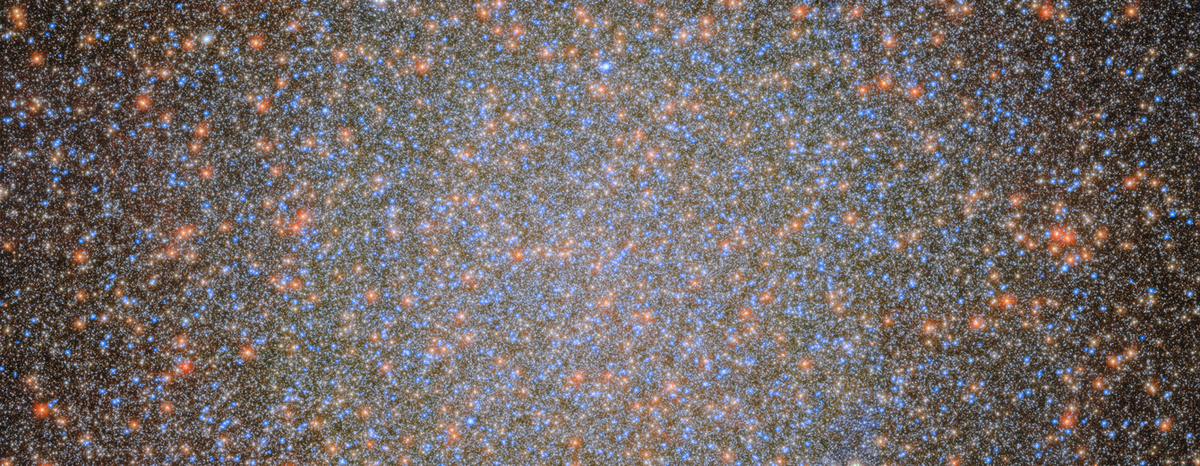
Omega Centauri is the Milky Way’s most massive globular cluster and contains millions of stars packed into a relatively small volume.
Models predict that many stellar-mass black holes should have formed there, yet direct observational evidence has been surprisingly scarce.

How astronomers found the black hole
Researchers tracked tiny changes in stellar positions using more than 20 years of Hubble astrometry and added recent Webb infrared measurements.
The visible star’s motion showed that it is orbiting an unseen compact object whose gravity cannot be explained by an ordinary star.
What the mass measurement tells us
The dark companion’s measured mass is about 4.46 times the mass of the Sun, placing it securely in the stellar-mass black-hole range.
The improved measurement rules out an earlier interpretation that the companion might instead be a neutron star.
The unusually long binary orbit
The pair is estimated to complete an orbit roughly every 94 years.
That very long period is important because it suggests the binary may have formed dynamically through interactions inside the crowded cluster rather than evolving as an isolated pair.
Why the cluster’s black holes seem missing
Theory suggests Omega Centauri may contain thousands of black holes left by massive stars.
They are difficult to find because isolated black holes emit little or no light, so astronomers often need to detect their gravitational effects on visible companion stars.
What follow-up observations can test
Longer time baselines will improve the orbital solution and mass measurement.
Similar searches in Omega Centauri and other dense clusters could reveal whether this system is unusual or simply the first member of a much larger hidden population.
Frequently asked questions
Is this a real astronomy result?
Yes. The article is based on the official mission or agency release linked below.
Are these images AI-generated?
No. The images referenced in this article are official NASA/ESA/JPL mission imagery or agency visual material.
Why is this useful for beginners?
The article explains the observation, the physics behind it, what scientists can conclude, and what still remains uncertain.