

NASA’s OSIRIS-REx mission returned pristine rocks and dust from asteroid Bennu. Here is how the sample was collected, what scientists have found, and why it preserves clues from the early Solar System.
Why NASA chose Bennu
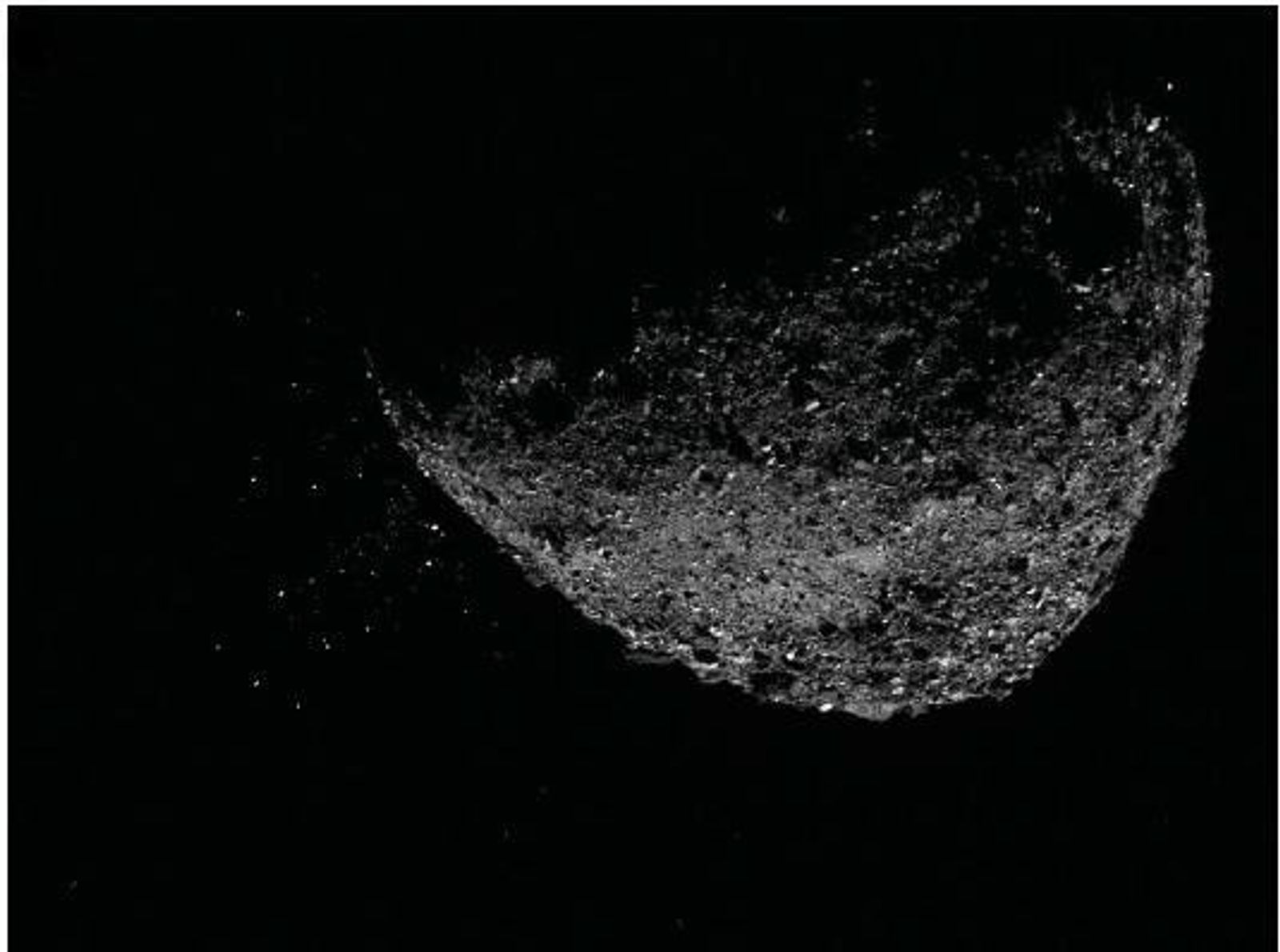
Bennu is a carbon-rich near-Earth asteroid whose material formed from ancient ingredients left over from the birth of the Solar System. Asteroids like Bennu have changed less than large planets, so their rocks can preserve chemical and mineral records that are billions of years old.
The asteroid is also accessible to spacecraft and has an orbit that brings it relatively close to Earth, making it a practical target for a sample-return mission.

How OSIRIS-REx collected the sample
Instead of landing for a long stay, OSIRIS-REx performed a brief touch-and-go maneuver in October 2020. A sampling head contacted the surface and released nitrogen gas, stirring loose material into a collection chamber.
The contact revealed that Bennu’s surface was far less cohesive than expected. The spacecraft sank deeper into the loose regolith than mission planners had anticipated, a dramatic reminder that small asteroids can behave more like loosely assembled rubble piles than solid rocks.
How the sample returned safely to Earth
After leaving Bennu, the spacecraft traveled back toward Earth and released a sample-return capsule. The capsule entered Earth’s atmosphere and landed at the Utah Test and Training Range on September 24, 2023.
Teams moved the sealed material into controlled clean-room facilities so researchers could study it while minimizing contamination from Earth.
What scientists are learning from Bennu
Laboratory analysis has found carbon-rich material, nitrogen-bearing compounds, organic molecules and minerals associated with water-altered environments. Researchers have also identified phosphates and evidence that some of Bennu’s parent material experienced salty water chemistry long ago.
These results do not show that life existed on Bennu. They do show that important chemical ingredients were present in primitive Solar System material and may have been widely distributed to young planets.
Why returned samples are more powerful than remote observations
Telescopes and spacecraft instruments can reveal composition from a distance, but laboratories on Earth offer far more sensitive measurements. Scientists can examine microscopic grains, isotopes and minerals with instruments too large or delicate to send into space.
A returned sample can also be preserved for decades. Future scientists can study the same Bennu material with techniques that have not yet been invented.
FAQ
Why is Asteroid Bennu Sample important?
It gives scientists a direct way to study how planets, moons or small bodies evolve and how conditions across the Solar System can differ dramatically.
Are these images real spacecraft or telescope observations?
Yes. The article uses real NASA spacecraft or telescope imagery and credits the mission or observing team in each caption.
Does this discovery prove life exists elsewhere?
No. Planetary discoveries can identify environments, chemistry and processes that are relevant to habitability, but evidence for life requires much stronger and more specific measurements.