

Saturn’s icy moon Enceladus sprays water vapor and ice from fractures near its south pole. Here is what the plumes reveal about the ocean beneath the crust and why the moon matters in the search for habitable environments.
How scientists know an ocean is hidden below the ice
Cassini did not drill through Enceladus. Instead, scientists combined several independent clues. The spacecraft measured tiny changes in its motion caused by the moon’s gravity, studied the way Enceladus wobbles as it orbits Saturn, and sampled material in the plume. Together, those observations are best explained by a liquid-water layer beneath the icy shell.
The ocean is especially important because it appears to communicate with the surface through fractures near the south pole. That means material from the interior can be studied without landing and digging through kilometers of ice.
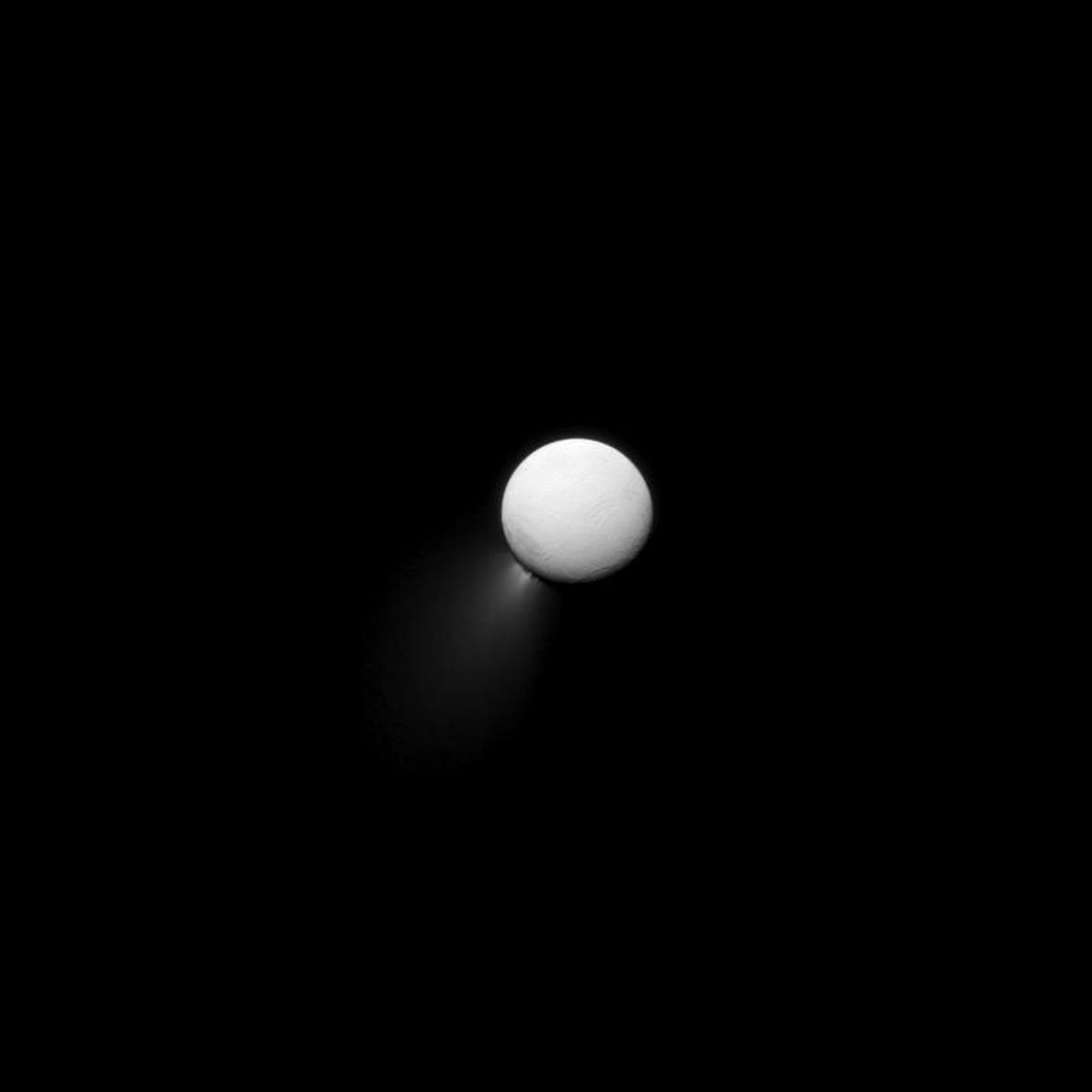
Why the south-polar “tiger stripes” produce jets
Long fractures near the south pole, informally called tiger stripes, are warmer than much of the surrounding terrain. Tidal forces from Saturn repeatedly flex Enceladus as the moon travels around its slightly eccentric orbit. That flexing helps keep parts of the interior warm and can open and close pathways through the ice.
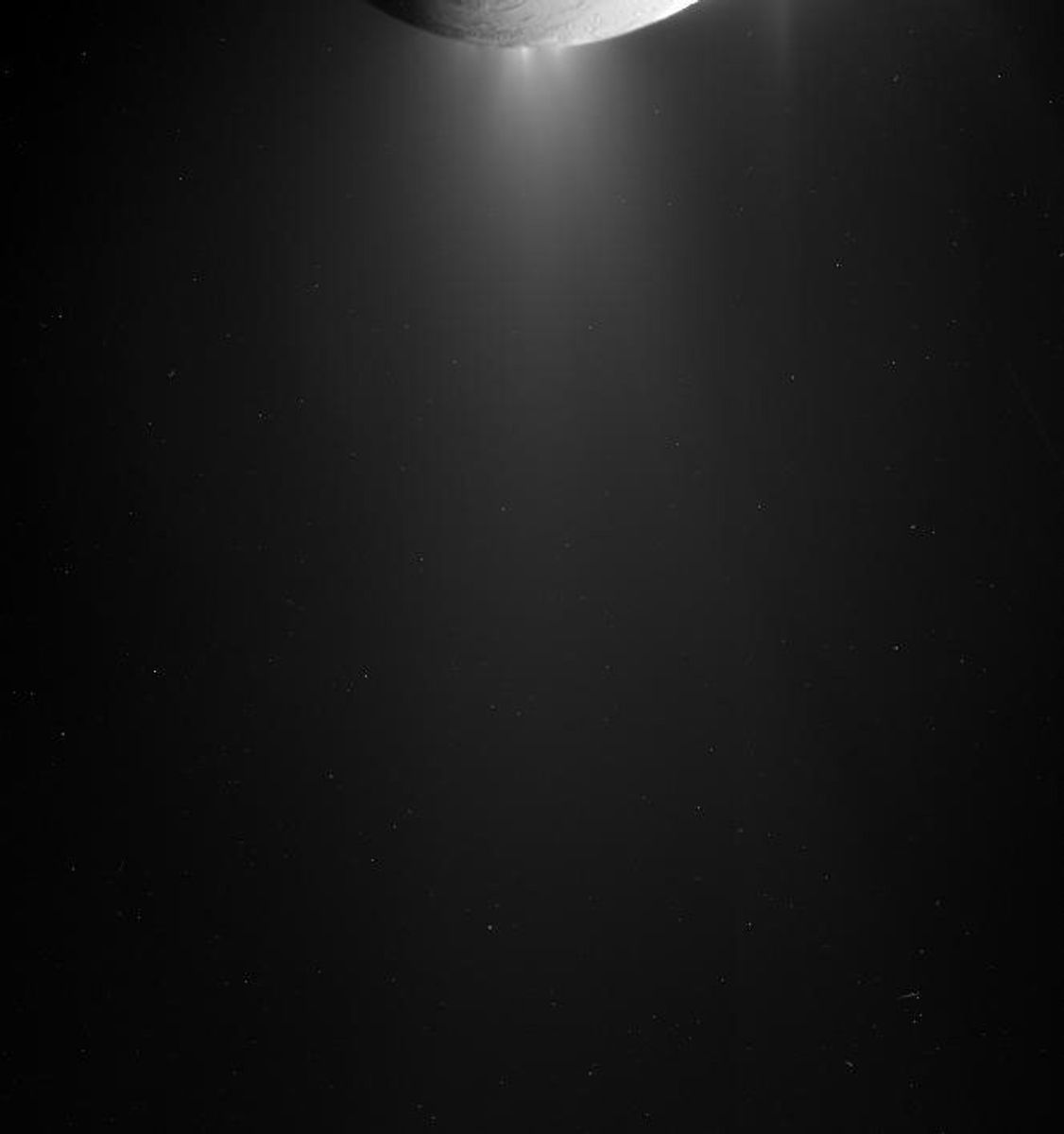
Water vapor, ice grains and other compounds escape through those fractures. The individual jets merge into a much larger plume that extends far above the surface and supplies particles to Saturn’s E ring.
What has been found in the plume
Cassini detected water, salts, silica particles and a range of organic compounds in plume material. Later analysis of Cassini data identified additional organic chemistry in fresh ice grains. Webb observations also measured a very large water-vapor plume extending far beyond the moon itself.
None of these measurements are proof of life. They do show that the ocean contains water, useful chemistry and energy sources that make Enceladus one of the most compelling places to investigate habitability.
Why Enceladus is a major astrobiology target
Habitability is about whether an environment could support life, not whether life has already been found. Liquid water, chemical building blocks and energy are three central ingredients. Enceladus offers evidence for all three.
Scientists are especially interested in possible hydrothermal activity on the ocean floor. On Earth, water-rock reactions around hydrothermal systems create chemical gradients that microorganisms can use. Similar processes may occur inside Enceladus, although a future mission would be needed to test that idea directly.
What a future Enceladus mission could measure
A dedicated mission could repeatedly fly through the plume with modern instruments designed to identify complex organic molecules, map the ice shell, measure heat flow and search for patterns in chemistry that are difficult to explain with simple geology alone.
Because Enceladus naturally ejects material into space, a spacecraft can sample the ocean indirectly. That makes the moon unusually accessible compared with ocean worlds where the liquid reservoir is sealed beneath an unbroken ice shell.
FAQ
Why is Enceladus Water Plumes important?
It gives scientists a direct way to study how planets, moons or small bodies evolve and how conditions across the Solar System can differ dramatically.
Are these images real spacecraft or telescope observations?
Yes. The article uses real NASA spacecraft or telescope imagery and credits the mission or observing team in each caption.
Does this discovery prove life exists elsewhere?
No. Planetary discoveries can identify environments, chemistry and processes that are relevant to habitability, but evidence for life requires much stronger and more specific measurements.