

Lucy is approaching the most important phase of its 12-year journey: the first spacecraft exploration of Jupiter’s Trojan asteroids. These ancient objects share Jupiter’s orbit around the Sun in two broad swarms and are thought to preserve important clues about how the outer Solar System formed and changed.
Why Lucy is testing its cameras before the flybys
From Earth, Jupiter Trojan asteroids are usually observed from nearly the same direction as sunlight. That geometry makes them appear more fully illuminated. Lucy, however, will see these bodies from very different angles as it passes them at close range.
During the actual encounters, large portions of each asteroid may be partly shadowed. If the camera exposure is too short, important surface detail could disappear into darkness. If the exposure is too long, brighter areas could become washed out.
By observing future targets in advance, mission scientists can study the asteroids under increasingly realistic lighting conditions. NASA says these tests help the team choose camera settings that will preserve surface detail during the brief, high-speed encounters.
The four Trojan asteroids Lucy is already watching
In spring 2026 Lucy used L’LORRI to observe Eurybates, Polymele, Leucus and Orus. The spacecraft was still hundreds of millions of miles away, so the asteroids appeared only as tiny points of light against the stars.
Even at that distance, the observations are useful. The team completed downlinking and processing the images in July 2026, providing an early look at the targets from Lucy’s unique position in the Solar System.
Two of these targets are already known to have small moons. Eurybates has a moon named Queta, while Polymele has an unnamed satellite. That makes careful imaging especially valuable because the spacecraft will need to characterize not only the primary asteroid but also nearby companions and potential hazards.
L’LORRI: Lucy’s high-resolution “eagle eye”
L’LORRI — the Lucy LOng Range Reconnaissance Imager — is the spacecraft’s highest-resolution camera. It is a panchromatic instrument, meaning it records visible light without color filters and produces detailed black-and-white images.
NASA says L’LORRI is designed to resolve craters as small as about 229 feet across from roughly 621 miles away. The camera will also help the science team examine surface geology, look for rings and satellites, and support optical navigation.
The instrument is based on the successful LORRI camera flown on New Horizons, which returned detailed views of Pluto and Arrokoth. Lucy’s version was modified for its own mission needs while preserving the proven optical design.
Why lighting geometry matters for asteroid imaging
Asteroids are not smooth spheres. Their surfaces are covered with slopes, ridges, craters and boulders that create sharp changes in brightness when sunlight strikes them from different directions.
NASA notes that Earth-based observers often see the Trojan asteroids nearly fully lit, similar to a full Moon. Lucy will instead see the surfaces from changing phase angles, with portions of the terrain entering deep shadow.
The 2026 test observations therefore help the team understand how the cameras respond before the mission reaches the much more demanding encounter geometry. Getting those settings right is especially important because the spacecraft will have only a short window to capture its best images during each flyby.
Lucy’s first four Trojan flybys
The spacecraft’s first Trojan encounter is scheduled for August 11, 2027, when Lucy will pass Eurybates and its moon Queta. It is then expected to fly by Polymele on September 14, 2027.
In 2028, Lucy is scheduled to encounter Leucus on April 18 and Orus on November 11. NASA says the spacecraft can be moving at up to about 16,000 miles per hour relative to the asteroids during these encounters.
That speed leaves very little room for correction at the last moment. The imaging sequence, pointing and exposure strategy all need to be planned carefully in advance, which is why distant target observations are so useful now.
Donaldjohanson gave Lucy a real-world rehearsal
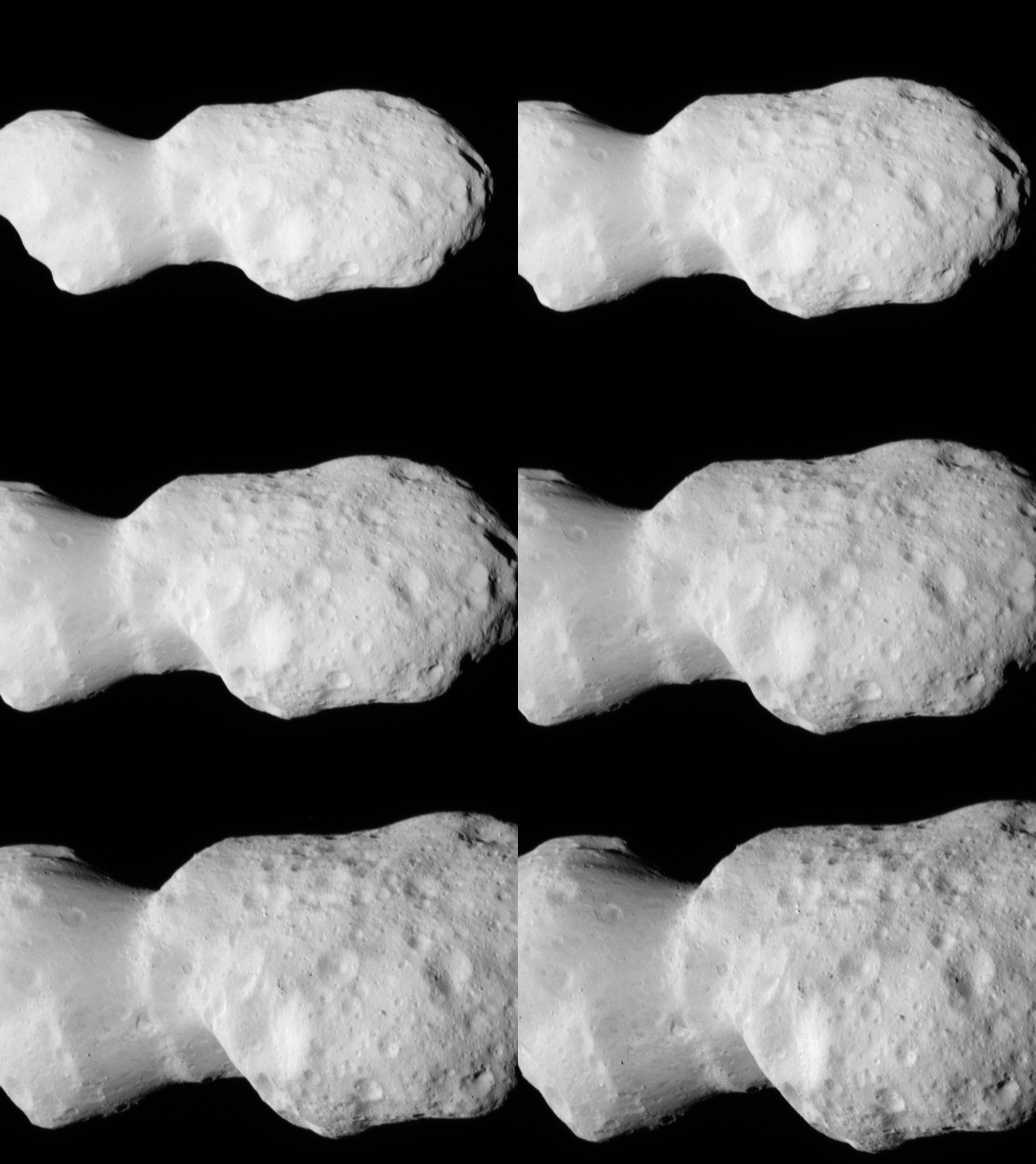
Before reaching the Trojan swarms, Lucy completed a close flyby of main-belt asteroid Donaldjohanson on April 20, 2025. The encounter provided the mission team with an opportunity to operate the instruments and autonomous tracking systems during a real high-speed asteroid flyby.
The resulting images showed Donaldjohanson to be an elongated, peanut-like world with a complex shape. NASA later reported that the object exhibits a wobbling rotation and evidence of a complicated collisional history.
That earlier encounter matters because it tested the same spacecraft, camera and mission operations that will be used during the Trojan campaign.
What the Trojan asteroids could reveal about the early Solar System
The Jupiter Trojans are considered primitive remnants of the Solar System’s early history. They occupy stable regions that move around the Sun with Jupiter, but they are not simply a uniform population of rocks that formed in one place.
Their wide range of colors, sizes and surface properties supports the idea that some may have formed in different parts of the young Solar System before being scattered and trapped into their present orbits.
By visiting multiple Trojan objects in a single mission, Lucy can compare their geology, composition, cratering and satellite systems. Those comparisons may help scientists test models of how the giant planets moved and how small bodies were redistributed billions of years ago.
Lucy’s mission timeline
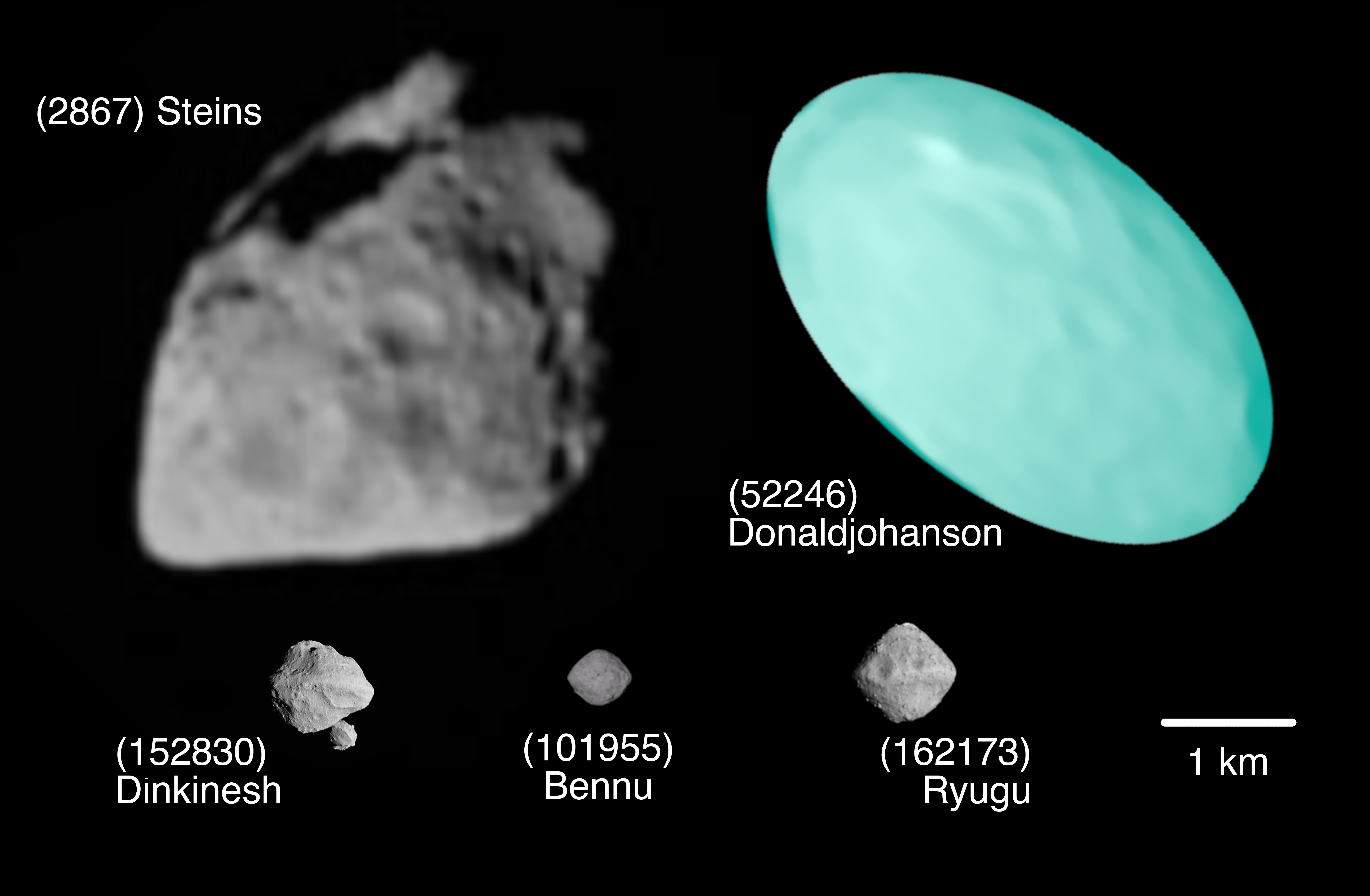
Lucy launched in October 2021. It has since used Earth gravity assists to reshape its orbit and completed flybys of the main-belt asteroids Dinkinesh in 2023 and Donaldjohanson in 2025.
The first Trojan encounters begin in 2027 and continue through 2028 with Eurybates, Polymele, Leucus and Orus. After another Earth gravity assist, the spacecraft is expected to reach the Patroclus-Menoetius binary Trojan system in 2033.
NASA describes Lucy as the first mission dedicated to exploring Jupiter’s Trojan asteroids and one of the most ambitious multi-target asteroid tours ever attempted.
Frequently Asked Questions
Why is Lucy photographing the Trojan asteroids so early?
The distant observations help the mission team test camera settings, exposure times and lighting conditions before the fast close encounters beginning in 2027.
Which Trojan asteroids were observed in the 2026 camera tests?
NASA says Lucy observed Eurybates, Polymele, Leucus and Orus with its high-resolution L’LORRI camera.
What is L’LORRI?
L’LORRI is Lucy’s highest-resolution visible-light camera. It is designed to capture detailed black-and-white images of asteroid surfaces and also assist with navigation and searches for rings or satellites.
When is Lucy’s first Trojan flyby?
Lucy is scheduled to encounter Eurybates and its moon Queta on August 11, 2027.
Why are Jupiter Trojan asteroids important?
They are primitive bodies that may preserve evidence of the early Solar System and the migration history of the giant planets.