

Astronomy is not limited to the colors human eyes can see. Stars, galaxies, clouds of gas and high-energy objects produce radiation across the electromagnetic spectrum. Radio observatories collect long-wavelength signals and turn them into measurable data, revealing structures often hidden from ordinary telescopes.
Why radio telescopes matter
Many important cosmic processes are much easier to study at radio wavelengths than in visible light. Cold neutral hydrogen emits radiation around 21 centimeters, while charged particles moving through magnetic fields can create stronger emission across broad radio bands.
Radio observations also penetrate through some types of dust that block visible starlight. That allows scientists to investigate parts of the Milky Way, nearby galaxies and active galactic nuclei that otherwise remain difficult to study.
What is radio astronomy?
Radio astronomy studies naturally produced radio-frequency radiation from celestial objects. Unlike a camera, a radio telescope does not record visible-light colors. It measures weak electromagnetic signals and maps their strength, frequency, polarization and timing.
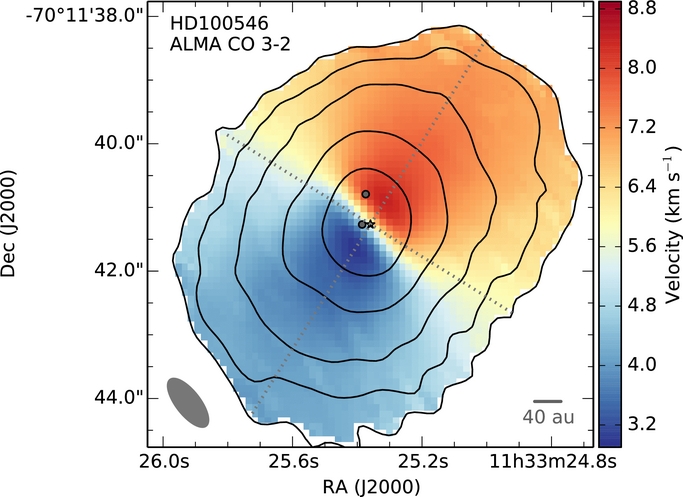
These measurements may later appear in color images. The colors in a scientific radio map are typically assigned by researchers to communicate properties of the data, such as intensity or velocity, rather than the colors a human eye would see.
How radio telescopes receive signals
A radio telescope uses an antenna, often a large curved reflector dish, to collect faint signals from a chosen region of the sky. The incoming waves are guided to sensitive receivers that amplify and convert them into digital measurements.
Computers remove instrumental effects, help identify unwanted interference and process the remaining signals into spectra or sky maps. Extremely precise timing is vital when combining measurements from antennas that are separated by large distances.
Why several dishes are better than one
Radio interferometry combines the signals from separate antennas to achieve much sharper resolution than a single dish can provide at the same wavelength. The greatest distance between dishes, known as the baseline, is particularly important for resolving small details.
The technique requires careful synchronization and calibration. Multiple antennas provide overlapping measurements of the sky, which software reconstructs into an image. Sensitivity and ability to detect extended emission depend on collecting area, antenna spacing and observing time.
Inside the Very Large Array
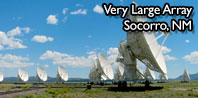
The Karl G. Jansky Very Large Array (VLA) in New Mexico has 27 large dishes, each 25 meters across, that move along tracks arranged in a giant Y configuration. By moving antennas closer together or farther apart, astronomers can change the array's resolution and sensitivity to structures of different sizes.
The VLA is used to explore star-forming gas, galaxies, exploding stars, magnetic fields and the energetic surroundings of black holes. Its many antennas observe the same target in concert rather than simply capturing separate photographs.
What radio astronomers can discover
Radio astronomy helps astronomers trace neutral hydrogen in galaxies and molecular gas in star-forming clouds. It can reveal pulsars whose rotating emission beams create repeating signals, and jets powered by activity near black holes.
Radio observatories also measure polarization, a useful clue to the magnetic fields around celestial objects. When observations from different wavelengths are combined, scientists can build a more complete picture of how matter and energy behave in space.
What radio images cannot tell us alone
A radio map is a scientific reconstruction, not an ordinary visible-light photograph. Colors often encode measurements and may not correspond to real visual colors. Limited resolution, imaging artifacts and missing measurements can affect what structures an array recovers.
Man-made radio signals can also interfere with faint cosmic sources. Astronomers therefore protect observatory sites, calibrate measurements carefully and compare data from several frequencies and kinds of telescope.
For broader background, see our How Space Missions Work guide and Night Sky Beginners Guide.
Frequently Asked Questions
Can radio telescopes take pictures?
They detect radio signals. Computers can reconstruct those measurements into scientifically meaningful maps and images.
Do radio telescopes hear sound from space?
No. Radio emissions are electromagnetic radiation, not ordinary sound waves; scientists can convert data into audio representations.
Why are some radio telescopes enormous?
Large antennas collect weak signals, and larger separations between antennas in an array can improve image resolution.
What is radio interferometry?
It is a technique that combines measurements from separated antennas to simulate the resolving power of a much larger instrument.
How many antennas does the Very Large Array have?
The Karl G. Jansky VLA uses 27 large movable antennas in a Y-shaped configuration.
Can radio telescopes see through dust?
Some radio wavelengths pass through clouds of dust that obstruct visible light, helping astronomers study hidden regions.