
Dragonfly is unlike any planetary mission NASA has attempted before. Instead of driving slowly across the surface like a rover, the mission is designed as a large nuclear-powered rotorcraft that can repeatedly fly from one science site to another on Titan. That mobility should allow a single spacecraft to investigate different types of terrain, chemistry and geology over a much wider area than a conventional stationary lander.
Why this milestone matters
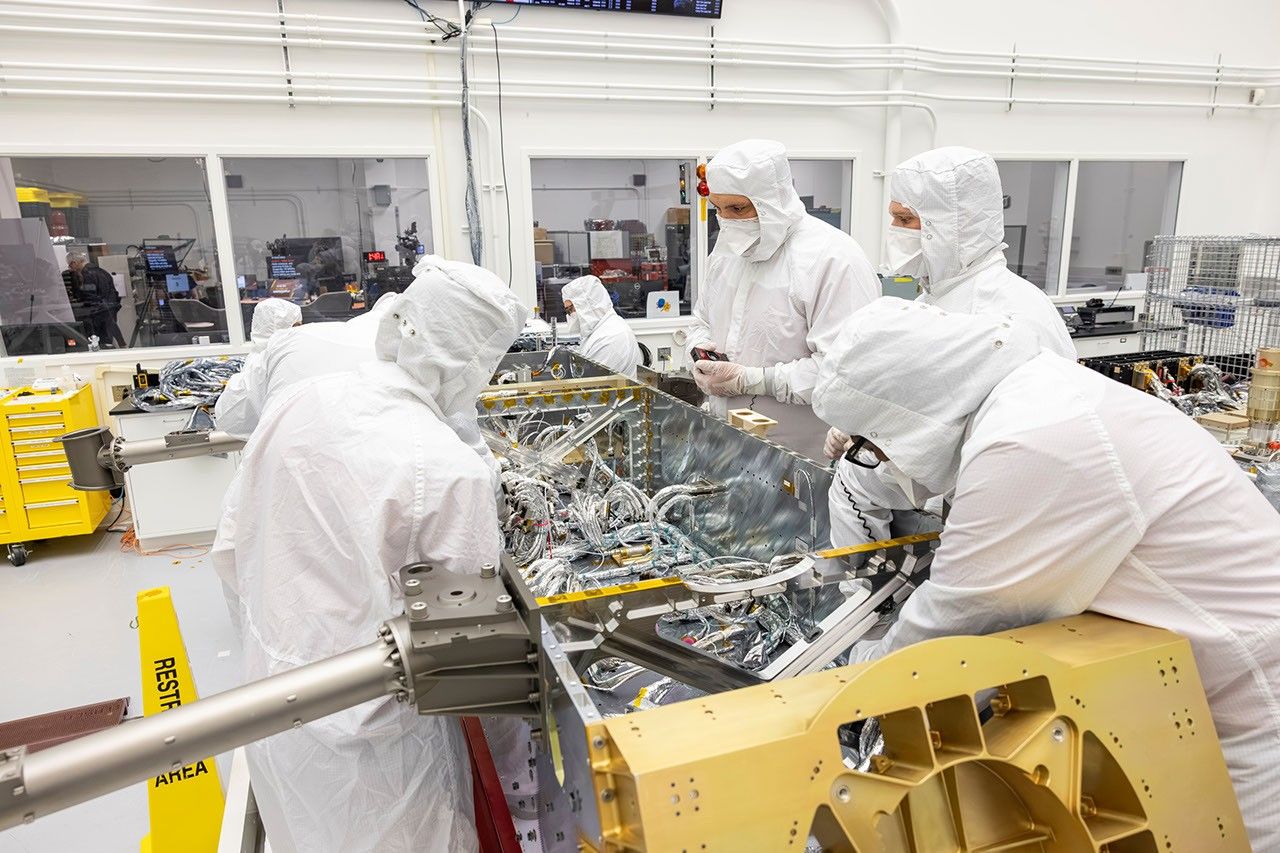
Spacecraft are assembled in layers. Structural elements must be ready before engineers can permanently route many electrical lines, and instruments cannot fully function until they are connected to power, command and data systems. For Dragonfly, the harness installation is therefore a major integration step.
NASA reported that the flight fuselage had already received remote interface units and temperature sensors before the harness team began laying the wiring. Once that network is in place, additional instruments and flight components can be connected as they arrive for integration and testing.
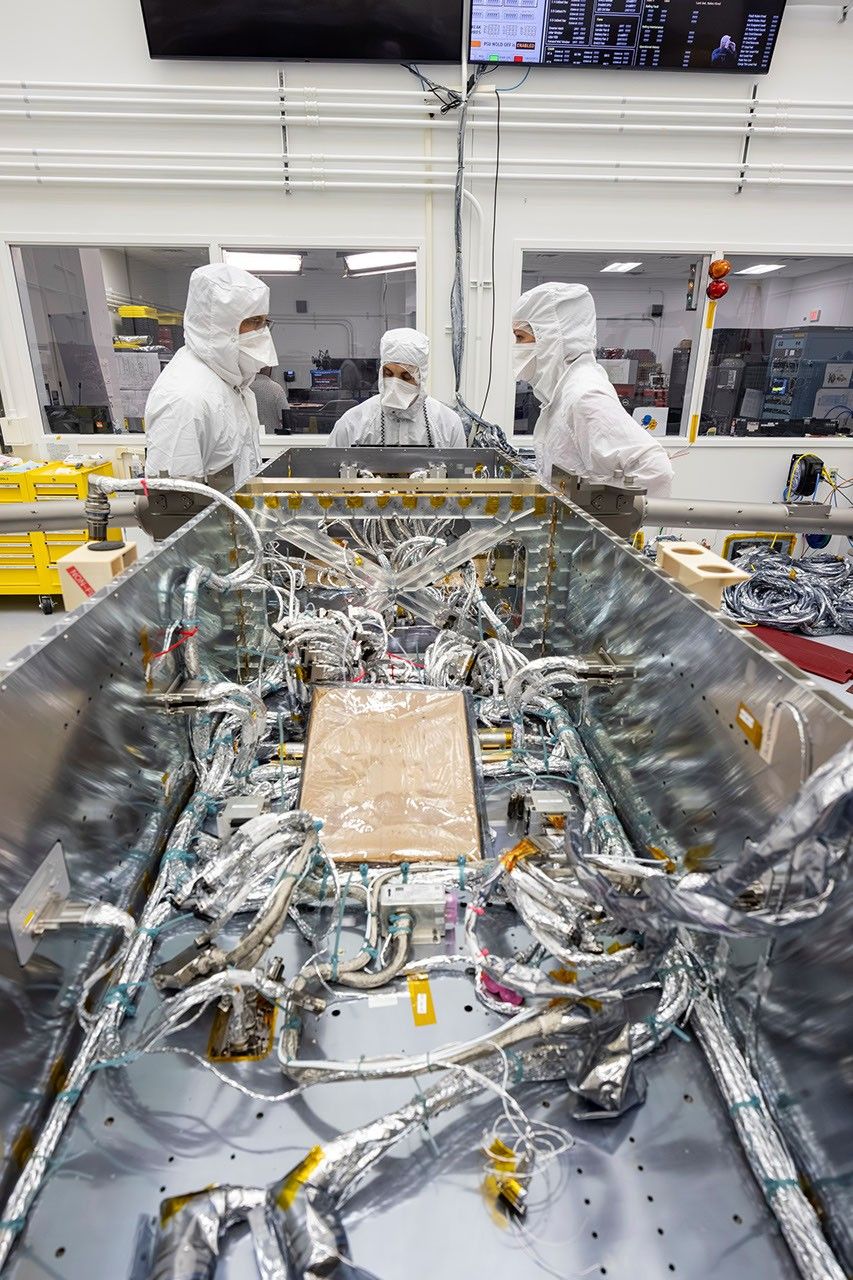
The result is not simply a bundle of wires. It is the physical communication network that allows the spacecraft’s computers, sensors, actuators, scientific instruments and battery to operate as one system.
Dragonfly’s electrical nervous system
NASA describes Dragonfly’s harness as the spacecraft’s nervous system. That comparison is useful because the wiring is responsible for carrying both electrical power and information. Commands must reach motors and instruments, measurements must return to the flight computer, and the spacecraft’s power system must reliably feed hardware spread throughout a tightly packed vehicle.
The conductors are made from silver-coated copper. NASA says the wiring is insulated with a durable heat-resistant polymer, wrapped with aluminum and connected through plastic and metal connectors. The design must survive launch vibration, years of interplanetary travel and the extreme cold encountered on Titan.
Key numbers behind Dragonfly’s wiring
The completed flight harness contains an estimated 17,315 feet of conductor wire and 374 connectors. NASA places its mass at about 100 pounds. Those numbers show how much electrical infrastructure is needed to operate a spacecraft that combines an aircraft, a science laboratory, a communications platform and a deep-space lander.
Dragonfly also has unusually high power demands for a planetary surface mission. NASA says the harness uses both 4-gauge and 8-gauge wire in some areas. Even with these relatively heavy conductors, the routing has to remain flexible enough to pass through a crowded interior filled with flight electronics, science hardware and a battery weighing nearly 300 pounds.
Why Titan makes the engineering difficult
Titan is extremely cold, so keeping the spacecraft warm is central to the design. Dragonfly uses a radioisotope power source, and the lander is insulated to retain heat. NASA has compared the basic thermal approach to a thermos bottle: heat must be conserved instead of allowed to escape rapidly into the environment.
That thermal strategy affects the electrical system. The harness has to pass beneath thick foam insulation on the lander’s exterior while still supporting warm-air circulation inside the vehicle. Engineers therefore have to balance electrical performance, flexibility, thermal protection, mass and physical space.
Titan’s environment is also the reason powered flight is so attractive. Its dense atmosphere and lower surface gravity make rotorcraft flight practical, allowing Dragonfly to travel between locations rather than being limited to a single landing site.
Ahmakiq Undae: the named landing region
While spacecraft integration continued on Earth, the International Astronomical Union approved an official name for the large Titan dune field where Dragonfly is expected to land: Ahmakiq Undae.
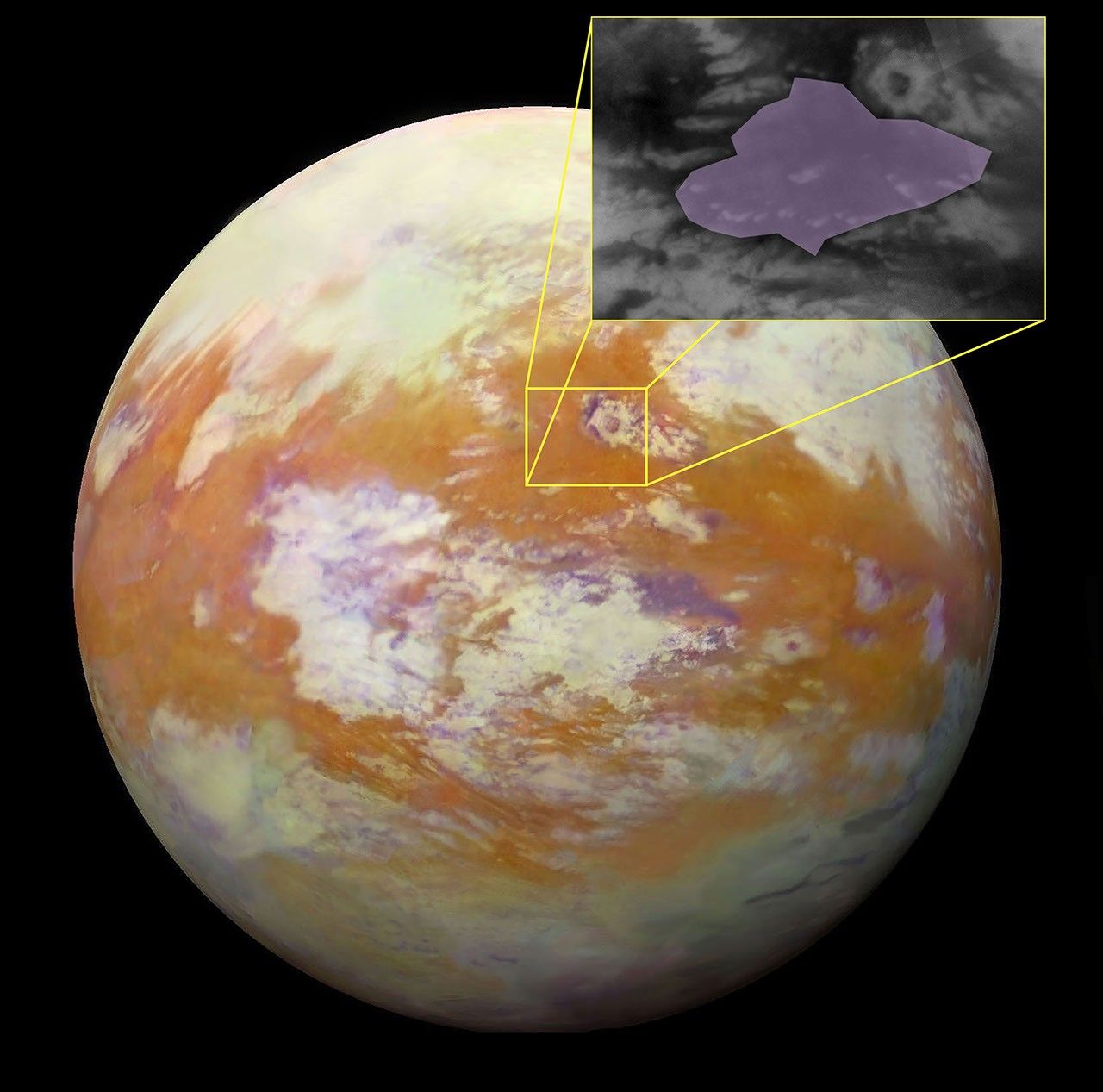
The region lies in Titan’s equatorial dune fields, south of Selk Crater. NASA describes Ahmakiq Undae as extending roughly 500 miles, or about 810 kilometers, across. The nearby Selk impact crater is about 50 miles, or roughly 80 kilometers, in diameter.
The name follows the IAU convention for Titan dune fields. In Mayan tradition, Ahmakiq is associated with stopping strong winds, and the name is commonly translated as “one who locks up the wind.” That connection makes it a fitting name for a vast field of dunes shaped by atmospheric processes.
Why Selk Crater matters to the science mission
The deposits associated with Selk Crater are among Dragonfly’s important exploration targets because an impact can temporarily change the physical and chemical environment of an icy world.
Scientific modeling indicates that the impact that created Selk may have melted icy bedrock and produced a temporary body of liquid water. NASA notes that, under an insulating layer of ice, liquid conditions could potentially have persisted for hundreds to thousands of years.
That possibility is scientifically important because Titan is rich in complex organic material. A place where liquid water and organic compounds may once have existed together offers a natural laboratory for studying prebiotic chemistry — the chemical processes that can precede biology.
Dragonfly’s launch, arrival and surface mission
NASA currently plans to launch Dragonfly in summer 2028. The interplanetary journey will take years, with arrival at Titan expected in late 2034.
Once safely on the surface, Dragonfly’s primary mission is planned to last about 3.3 years. Instead of remaining in one place, the rotorcraft will make repeated flights between science locations, examining dunes, interdune terrain and material associated with impact processes.
That mobility is one of the mission’s defining advantages. A stationary lander can study one local environment in great detail, while Dragonfly is designed to compare multiple environments and build a broader picture of Titan’s surface and chemistry.
What scientists hope Dragonfly will learn
Dragonfly will investigate Titan’s organic chemistry, surface composition, atmospheric conditions and geological history. One of the mission’s central goals is to understand how far complex chemistry can progress in environments that are very different from modern Earth.
Titan has a thick nitrogen-rich atmosphere, hydrocarbon lakes and seas, organic dunes and a likely water-rich interior. Those features make it one of the most chemically complex worlds in the Solar System.
Dragonfly is not being sent to claim that life exists on Titan. Instead, it will examine the ingredients, processes and environments that help scientists understand habitability and the chemical steps that may occur before life emerges.
Frequently Asked Questions
What is Dragonfly?
Dragonfly is a NASA rotorcraft lander designed to explore multiple locations on Saturn’s moon Titan. It is part of NASA’s New Frontiers program.
Why does Dragonfly need such a large wiring harness?
The vehicle combines flight systems, navigation, communications, science instruments, sensors, actuators, thermal systems and a large battery. The harness distributes power and data among those systems.
How much wire is in Dragonfly?
NASA says the flight-ready electrical harness contains an estimated 17,315 feet of conductor wire and 374 connectors.
Where will Dragonfly land?
The mission is expected to begin in Ahmakiq Undae, a large equatorial dune field near Selk Crater on Titan.
When will Dragonfly reach Titan?
NASA currently plans a summer 2028 launch, with arrival at Titan expected in late 2034.
Why is Selk Crater important?
The impact that created Selk may have melted Titan’s icy crust and temporarily brought liquid water together with complex organic material, making the region valuable for studying prebiotic chemistry.